
RVYUAN vs Traditional Components: Assessing the ETFE Extruded Litz Wire for Transformer Solution Provider
Nov 5, 2026
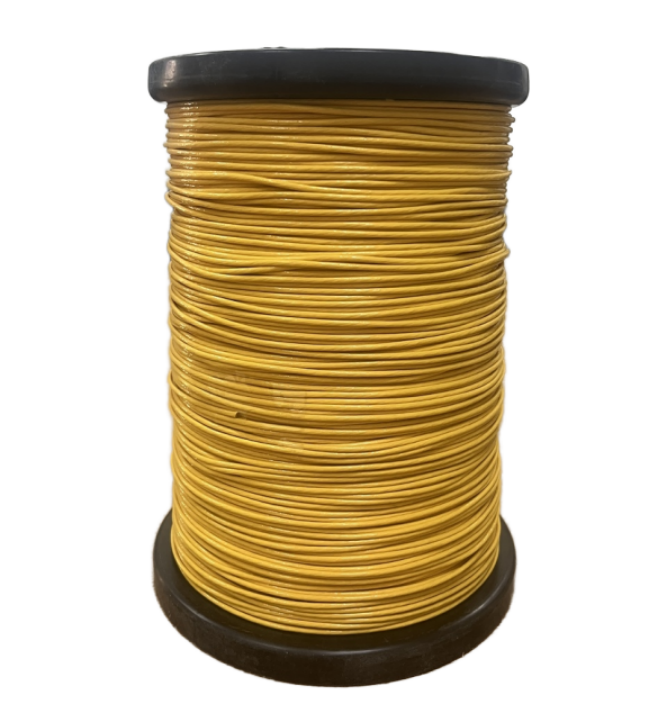
Tianjin, China Nov 4, 2026 (Issuewire.com) - When your transformer runs hot at 200 kHz and the insulation starts giving way, the winding material is usually the culprit. Picking the right ETFE extruded litz wire for transformer solution provider comes down to one question: can the wire handle both the frequency-driven losses and the voltage stress without forcing you to oversize the core? RVYUAN--Tianjin Ruiyuan Electric Material Co.Ltd --builds their answer around a single-pass extrusion process that puts 5000V to 6000V dielectric strength into a jacket thin enough to actually save bobbin space. Here's how that stacks up against what most engineers have been winding with for years.
What Goes Wrong With Conventional Litz Wire at High Frequencies?
The short answer: the insulation gives out before the copper does.
At frequencies above 100 kHz, skin effect pushes current to the outer edge of each conductor. Fine-stranded litz wire handles that part reasonably well by splitting the cross-section into dozens or hundreds of thin filaments. The electrical principle is sound. But the outer jacket--that's where things fall apart in practice.
Silk-served and nylon-wrapped litz wires pick up moisture from shop air. I've seen insulation resistance drop measurably on spools that sat in a warehouse through one humid summer. Polyurethane enamel on individual strands typically breaks down somewhere below 3000V, which leaves very little margin in designs that need reinforced insulation between primary and secondary.
Then there's the mechanical side. Run textile-covered litz wire through a high-speed winding machine and you'll find frayed fibers jamming the tension guides within a few hundred meters. The workaround most manufacturers use--adding layers of insulation tape between winding sections--eats into your available window area. You end up with a bigger core, a heavier transformer, and a longer bill of materials. None of that moves in the right direction for modern power density targets.
How Does RVYUAN's ETFE Extrusion Solve These Problems?
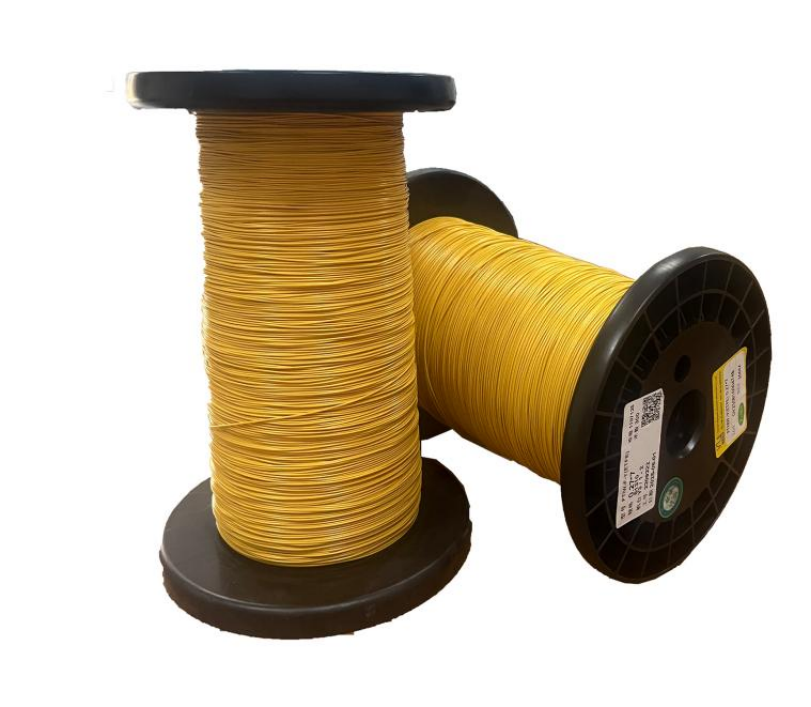
RVYUAN skips the wrapping step entirely. Their process takes 250 strands of 0.1 mm enameled copper wire, twists them into a flexible bundle, and runs that bundle straight through an extrusion die that applies molten ETFE in one continuous pass.
No seams. No overlap points. No air pockets trapped between a tape layer and the conductor surface.
That last point matters more than it might seem. Trapped air inside insulation is where partial discharge starts. Once partial discharge initiates, it erodes the polymer from the inside out--and you won't catch it on incoming inspection. A monolithic extruded wall eliminates that failure mode by design rather than by quality screening.
The finished wire hits these numbers:
Dielectric breakdown: Min.5000V
Thermal class: F rating, continuous operation at 155 degrees Celsius
Strand count: 250 individual filaments at 0.1 mm each
Surface friction: low enough for high-speed automated winding without surface damage
Because the ETFE wall is thinner than an equivalent tape-wrap stack at the same voltage rating, engineers get back usable winding space. In a tight bobbin, that recovered area translates directly into either more turns or a smaller core selection.
Why Pick ETFE Over PVC, Nylon, or Fiber Wraps?
Each conventional material has a specific failure mode that ETFE sidesteps.
PVC goes soft when temperatures climb and turns brittle after extended heat exposure. It works fine in low-frequency, low-temperature applications. Put it inside a 150-degree transformer and PVC is generally not the preferred insulation system for long-life performance.
Textile wraps--such as silk or nylon fiber--are industry standards for high-frequency Litz wires, offering exceptional flexibility and minimizing AC losses. In applications involving aggressive solvents, elevated sustained temperatures, or sharp-edged core geometries, the insulation system selection--including served constructions--warrants careful evaluation against the specific environmental and mechanical stresses involved.
ETFE extruded litz wire provides thinner high-voltage insulation than many tape-wrapped alternatives, helping recover winding window space in high-frequency transformers.
ETFE is well suited to those combined thermal chemical, and mechanical stresses. It resists acids, oils, and industrial cleaning solvents. It doesn't swell in varnish, and ETFE extruded wire maintains toughness across a wide operating temperature range. And its mechanical toughness means it survives being pulled around tight corners on a rectangular core without developing micro-cracks in the insulation wall. For engineers who've dealt with random field failures traced back to insulation defects, that kind of robustness changes the reliability conversation entirely.
Each litz wire construction has its own strengths. ETFE extruded litz wire is often selected when designers need a combination of high dielectric strength, compact insulation build, and durable automated winding performance, while served and tape-wrapped constructions remain widely used in many established transformer designs.
What Should You Actually Verify Before Qualifying a Supplier?
Data-sheets tell you what a product is designed to do. Production records tell you whether it actually does it consistently. When evaluating an ETFE extruded litz wire for transformer solution provider, three verification layers separate a reliable source from a risky one.
- Concentricity monitoring.
During extrusion, the ETFE wall thickness needs to stay uniform around the full circumference of the bundle. A thin spot on one side becomes the weak link for voltage breakdown. RVYUAN tracks this with real-time laser micrometers on the production line. Ask for the concentricity logs from your specific production batch--not just a generic capability statement.
- Spark test records and breakdown voltage statistics.
Every meter of wire should pass through an inline spark tester during manufacturing. But the real indicator of process control is the statistical spread across a full production lot. Tight clustering of breakdown voltage values around the 5000V to 6000V range confirms that the extrusion parameters stayed stable throughout the run.
- Lead time and MOQ flexibility.
Engineering teams prototyping a new transformer design can't wait twelve weeks for wire or commit to a full container load. RVYUAN sets their minimum order at 1000 meters for custom specifications, with standard fulfillment running 7 to 10 days. That's practical for validation builds and pilot production without tying up working capital in excess inventory.
Where Does This Wire Make the Biggest Difference?
LLC resonant converters, phase-shifted full-bridge topologies, flyback transformers for medical isolated supplies--basically any design where frequency exceeds 100 kHz and safety standards demand reinforced insulation between windings.
Take a concrete example. In a 500W LLC converter running at 200 kHz, swapping conventional served litz wire for ETFE extruded litz wire typically recovers 10 to 15 percent of the winding window. That's not a theoretical number pulled from a simulation. It comes from the difference in outer diameter between a tape-insulated bundle rated for equivalent voltage and the thinner extruded alternative.
What do you do with that extra space? Either wind more turns for tighter inductance control, or drop down one core size and save on magnetics cost and board footprint. Either path improves the end product. For designs targeting IEC 62368 safety certification, the high dielectric rating of the ETFE jacket can satisfy reinforced insulation requirements with fewer supplementary tape layers--simplifying the winding procedure and reducing operator-dependent quality variation.
Getting Started With RVYUAN for Next Transformer Build
If you're in the middle of a design where conventional litz wire is forcing compromises--bigger cores, extra insulation layers, marginal hipot results--it's worth running a comparison build with ETFE extruded wire before locking your transformer geometry.
RVYUAN provides specification sheets, cross-section samples, and application guidance through https://www.rvyuan.com/. Engaging during the electrical design phase rather than after mechanical drawings are frozen gives you the most flexibility to capture the space and efficiency gains that the extrusion architecture enables. Their 1000-meter MOQ and 7 to 10 day turnaround make it realistic to get sample material on your bench without a major procurement commitment.
Media Contact
Tianjin Ruiyuan Electric Material Co.Ltd
+86 22 8833333
22th building, Jinlian Economic Industrial Park, 300350, Shuanggang Town, Jinnan District, Tianjin City
Source :Tianjin Ruiyuan Electric Material Co.Ltd
This article was originally published by IssueWire. Read the original article here.
More News












Recommended



4 arrested in Lucena City drug den raid


YOUR NEWS, OUR NETWORK.
Do you have Great News you want to tell the world?
Be it updates about your business or your community, you can make sure that it’s heard by submitting your story to our network reaching hundreds of news sites across 6 verticals.