
ACondor Explains How Buying Power Reduction Sets Iron Condor Position Size
Oct 24, 2026
ACondor LLC explains what buying power reduction means on a defined risk iron condor, why a single trade's number is the wrong figure to plan an account around, and how its software for tastytrade accounts turns three buying power limits into a position size.
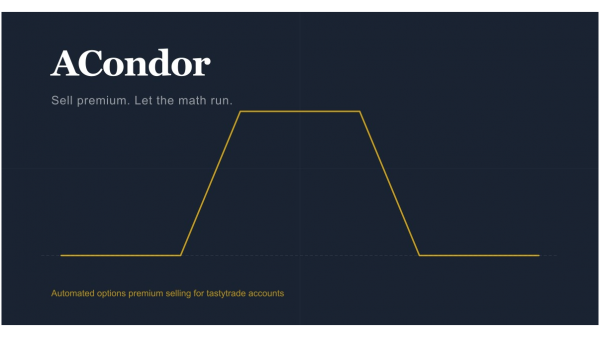
Las Cruces, United States, October 24, 2026 /NewsNetwork/ -- Buying power reduction is the figure an options broker sets aside while a position is open, and for premium sellers it is the number that decides how large any one trade can be and how many trades an account can carry. ACondor LLC, the company behind the ACondor options trading software for tastytrade accounts, has published an explanation of how buying power reduction works on an iron condor and how its software uses it to size positions before every entry. Account requirements are listed at https://acondor.com/requirements
According to the company, buying power reduction on a defined risk iron condor is simpler than on most short option trades. An undefined risk position such as a short strangle carries a margin requirement that moves with price and implied volatility. An iron condor has long wings that cap the worst case, and because the underlying can only finish beyond one side at expiration, the broker holds the risk of one side, not both. The requirement is the width of the wider spread times 100, minus the credit collected. A 10 point wide condor that collects $2.00 sets aside $1,000 less $200, or $800 per contract. On a defined risk trade that $800 is also the maximum loss, so the capital set aside and the worst case are the same number.
The company notes a consequence many newer premium sellers find counterintuitive: a richer credit on the same width uses less buying power, not more, because the credit is subtracted from the wing width. The second side of a condor adds credit without adding risk, which is why a full condor can tie up less capital than a single credit spread of the same width.
The harder question, in the company's view, is not what one condor costs but how many an account should hold. A systematic premium selling approach depends on many small occurrences spread across underlyings and expiration dates. An account that can afford one condor is not necessarily sized to run a strategy. ACondor answers that question with three limits, each of which binds at a different account size, and checks all three before any order is sent.
The first limit is risk per trade, set as a share of net liquidating value. ACondor's risk profiles set it at 3 percent (Conservative), 5 percent (Balanced), and 8 percent (Active). This is the limit that sets a practical account floor. A standard 10 wide index condor at 20 delta risks roughly $700 to $900 depending on the credit; the software plans around $900 so its position counts are never optimistic. At a 5 percent cap, a $900 condor needs about $18,000 of net liquidating value; at 3 percent, about $30,000. A dollar ceiling also runs the other way: no single trade may risk more than $1,000 regardless of account size, so a larger account takes more of the same small trade rather than a bigger one.
The second limit is allocation, the share of the account the software may deploy across all of its open positions at once: 20, 35, or 50 percent of net liquidating value by profile. This is what turns a per-trade figure into a position count. On a $30,000 account, a 35 percent allocation allows about $10,500 deployed, or roughly eleven condors at $900 each.
The third limit is an account-wide buying power ceiling. The allocation limit counts only positions the software opened. The ceiling counts everything in the account, including trades placed by hand, and is measured against the broker's own buying power figure. By risk profile, no more than 50, 70, or 80 percent of the account's buying power may be in use at once, and an entry that would cross that line is refused. The company's reasoning is that free buying power is what allows a tested position to be rolled or closed on the trader's terms rather than forced at the worst moment.
Before placing any order, ACondor asks tastytrade for a dry run of the trade, which reports the broker's own buying power effect and fees, and checks the result against all three limits. The software does not shrink a trade to make it fit. When a limit refuses an entry, the dashboard shows which limit fired and why. Risk profile limits re-derive only when account value moves 20 percent from where they were last set, so a strong or weak week does not quietly change position size.
In IRA and cash accounts, ACondor reads the account type from tastytrade and restricts itself to defined risk structures automatically, a restriction that cannot be overridden.
ACondor is software, not investment advice. Nothing here is a guarantee of any trading result, and options trading carries substantial risk of loss. Sizing limits control how much of an account is exposed to any one trade; they do not prevent losses.
Traders who want buying power limits enforced on every entry in a tastytrade account can request early access at https://acondor.com/early-access
Contact Info:
Name: Robin Lilly
Email: Send Email
Organization: ACondor LLC
Address: 2521 North Main Street, Las Cruces Unit 1-276, Las Cruces, New Mexico 88001, United States
Phone: +1-575-312-9326
Website: https://acondor.com
Source: NewsNetwork
Release ID: 89207264
In the event of any inaccuracies, problems, or queries arising from the content shared in this press release, we encourage you to notify us immediately at [email protected] (it is important to note that this email is the authorized channel for such matters, sending multiple emails to multiple addresses does not necessarily help expedite your request). Our diligent team will be readily available to respond and take swift action within 8 hours to rectify any identified issues or assist with removal requests. Ensuring the provision of high-quality and precise information is paramount to us.
More News










Recommended


JT Group seeks to future-proof tobacco business








YOUR NEWS, OUR NETWORK.
Do you have Great News you want to tell the world?
Be it updates about your business or your community, you can make sure that it’s heard by submitting your story to our network reaching hundreds of news sites across 6 verticals.